
Smarter bidding across every goal
In June we said the new release wasn't déjà vu. This time, déjà vu is actually the point.
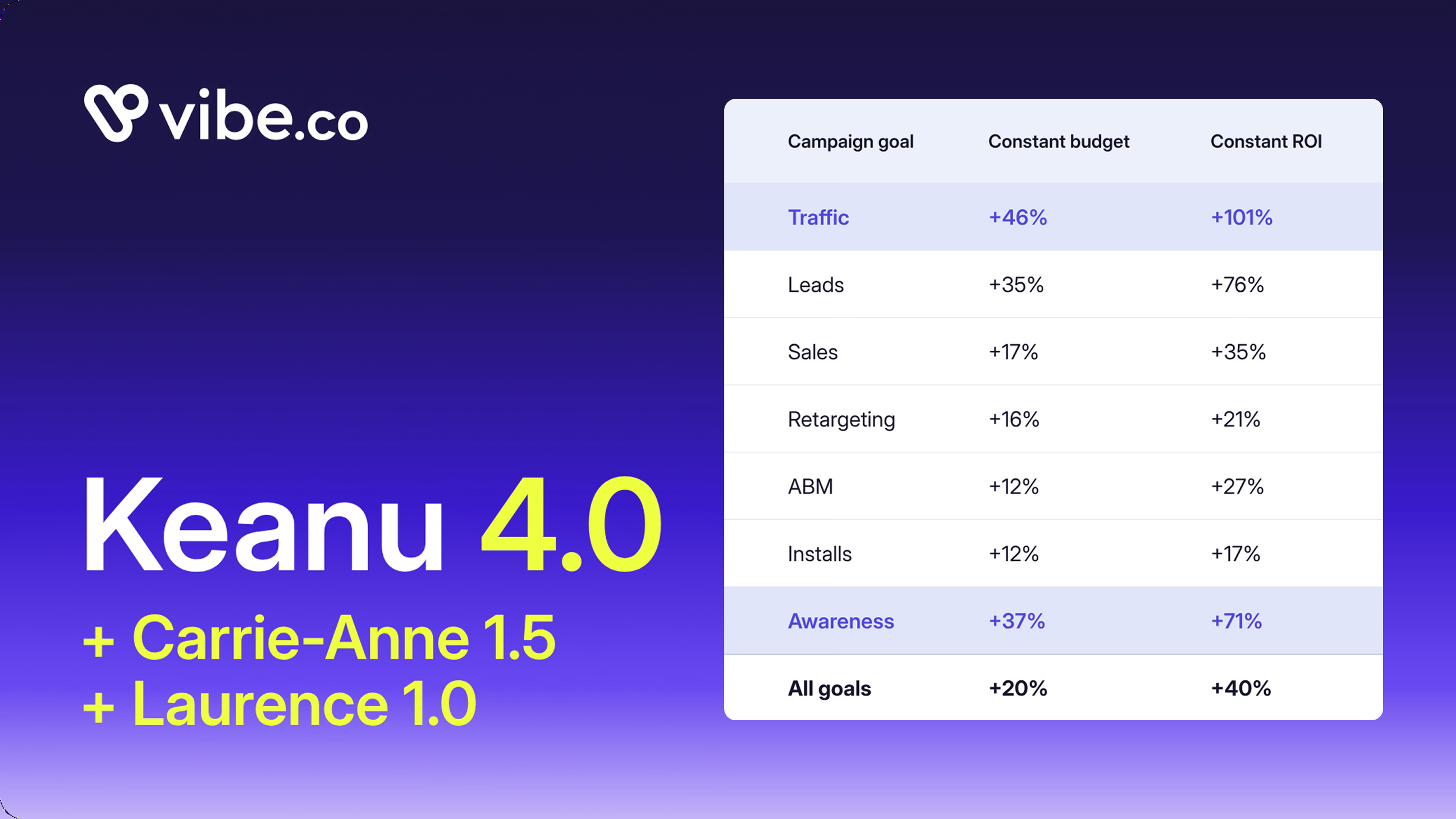
Starting today, every campaign on Vibe.co runs on a new bidding stack. Keanu 4.0, Carrie-Anne 1.5 and Laurence 1.0 are live across all campaigns, with no action required on your end.
In live A/B tests, the combined release delivered +26% more outcomes at constant budget (equivalent to +40% at constant ROI) across performance goals. Traffic gained +44% and Leads +35% at constant budget. Awareness campaigns reached +36% more unique households for the same spend.
Three releases, one stack
Every bid Vibe.co places answers 3 questions at once:
- Valuation, owned by Keanu: how much is this impression worth to you
- Pricing, owned by Carrie-Anne: given that value, what is the right amount to pay in this specific auction
- Memory, owned by Laurence: will this household remember your brand
Keanu 4.0: Value
Keanu 4.0 is a new architecture for our prediction model. It reads the household, the content, the moment and the device together, and learns how those signals combine. The result is a sharper estimate of what each impression is worth to your campaign.
Keanu 4.0 also knows when a household is not worth a bid. In CTV, the same household can come back to auction several times before the publisher confirms your ad played. Keanu no longer pays twice for a viewer you have already reached, and that budget goes to someone new.
Keanu 4.0 delivers +14.5% more outcomes at constant budget, with the largest gains on Traffic and Leads.
Carrie-Anne 1.5: Price
Knowing what an impression is worth does not tell you what the auction will take. Carrie-Anne 1.5 improves the model that predicts, for every auction, how likely we are to win at each price.
It works like the Oracle: it can't change the auction, but it knows how the auction will go before we bid. So Vibe.co bids what the auction requires and stops paying a safety margin on top. That margin goes back into your campaign.
Carrie-Anne 1.5 delivers +4.4% more outcomes at constant budget, led by Sales (+7.9%), Installs (+5.6%) and Retargeting (+4.6%).
Laurence 1.0: Memory
Linear TV sold Awareness as the blue pill: buy a spot, receive an estimated audience, assume everyone watching remembers.
Memory works differently. Research shows two things: recall fades quickly without reinforcement, and each well-timed reminder slows the fading. An impression on a household that saw your ad an hour ago adds almost nothing. An impression on a household that is starting to forget does the most work.
We call this the Memory Score: how strongly each household still remembers your brand. Added up across your audience, it measures what Awareness is actually for: how many households still remember your ad, not just how many saw it once.
Laurence 1.0 is our first Awareness bidder built on this idea. It shifts impressions away from overexposed households, where another ad no longer improves recall, and toward households that haven't seen your ad yet, or to the right moment to remind one that's starting to forget.
The result is +35% more unique households reached at constant budget, and +36% with the rest of the release.
Awareness now has what defines a performance objective: an outcome you can measure, a bidder that acts on it, and an A/B test that proves the gain. On Vibe.co, you can measure and optimize Awareness like any other line in your media plan.
Results
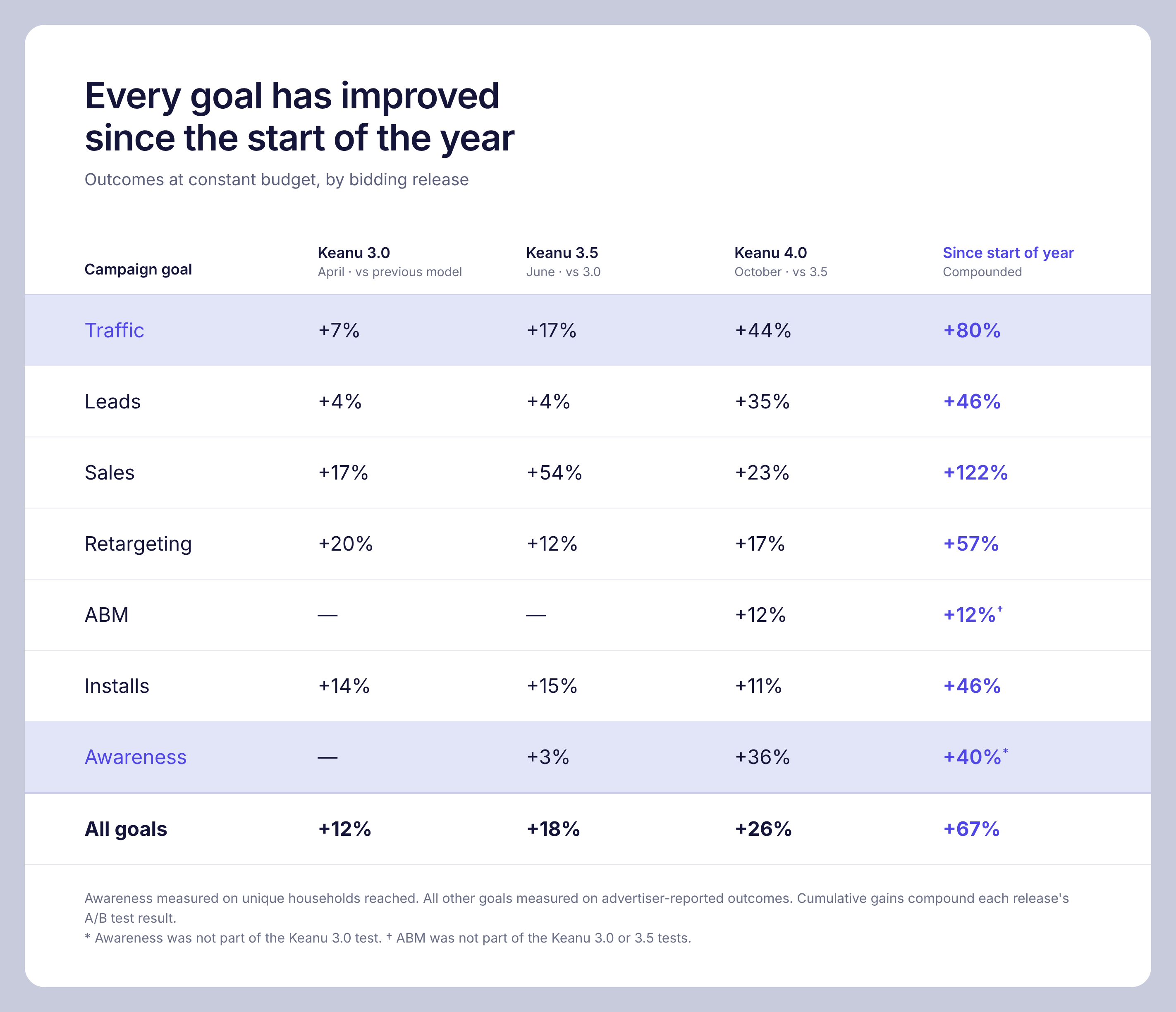
Every goal has improved.
What's next
There is more down the rabbit hole. Next, the stack will learn to bid on the outcomes your ads cause, to match each household with the creative that works best for it, and to make even better use of memory in all campaigns.
Welcome to the real world
On Vibe.co, every goal, from Sales to Awareness, has an outcome, a model that bids on it, and a live A/B test that measures the result. Each release in this post was proven in those tests, and each one is already running in your campaigns.
Methodology
How to read the two metrics
- The constant budget view shows how much more your current budget delivers. A +44% result for Traffic means a campaign that drove 100 site visits a week now drives 144, at the same cost.
- The constant ROI view shows how much further you can scale before reaching the cost per outcome you already accept. We model it with Vibe's budget-to-outcome elasticity system.
Both views improved across every goal. Your campaigns are more efficient today, and you have more room to scale them at the same cost per result.
Every release was evaluated in live A/B tests, with equal budget on each side. Performance goals are measured on advertiser-reported outcomes, Awareness on unique households reached. Combined figures compound the individual test results. Constant ROI figures use Vibe's budget-to-outcome elasticity model and represent modeled projections, not directly observed outcomes.

Fairing on Vibe: post-purchase answers become CTV conversions
Fairing on Vibe: post-purchase answers become CTV conversions
Connect Fairing to Vibe so your streaming TV channels appear in your post-purchase survey, and the customers who credit TV come back as conversions.
Design in Canva, run on TV
Vibe is now the first CTV destination in Canva's publish menu. Design a video ad in Canva and publish it straight to your Vibe creative library.
Introducing Omnisend for Vibe
Sync Omnisend segments to Vibe and run them as Streaming TV audiences.
Introducing Vibe CLI
Run CTV campaigns from your terminal or coding agent with Vibe CLI. Query performance, launch campaigns, and script the repetitive work. Live now.
Introducing Stella for Vibe
Vibe now connects to Stella, so performance marketers can measure CTV with causal proof, not guesswork.

Get started with Vibe
in minutes.


Industries
© 2026 Vibe, Inc.