
How Vibe’s Growth Team Launched 250 Personalized Campaigns in less than 15 Minutes
First in the Vibe for Vibe series, tied to the Vibe AI product suite.
Every growth team runs into the same tradeoff. Personalize a campaign for each account, and setup time multiplies with every account you add. Automate to save time, and the personalization disappears. Vibe’s team had faced this challenge, until we launched the full suite of Vibe Public APIs. Vibe’s VP of Growth & Marketing, Romain Marsal, leveraged the API to launch 250 personalized ABM campaigns - one per target account, in a matter of minutes.
“I don't think AI saves companies money. I think it lets you spend your marketing budget in the right place. Instead of paying five people to run five platforms, you can put that budget into the creative and strategy that people actually see. ”
What 250 Personalized Campaigns Entailed Before
Romain leads growth marketing at Vibe. The team works across every platform a performance marketer touches. Before AI entered the workflow, that meant one specialist mastering the configuration quirks of each one: launch a campaign, check performance, tweak the audience, iterate on creative, then do it again for the next platform.
That became a real bottleneck when Romain's team set out to run true account-based marketing: a dedicated CTV campaign for each of 250 target accounts, each with its own matched audience and matched creative.
Configured manually, a campaign like this takes roughly 10 to 30 minutes: targeting, audience, creative assignment, review. Multiply that across 250 accounts and you get 40-125 hours of manual setup before a single impression airs. Per Demand Gen Report’s 2026 ABM Benchmark Survey, marketers now rank personalization at scale as AI's single biggest impact on ABM, ahead of targeting or content creation. Romain's team ran into that exact wall.
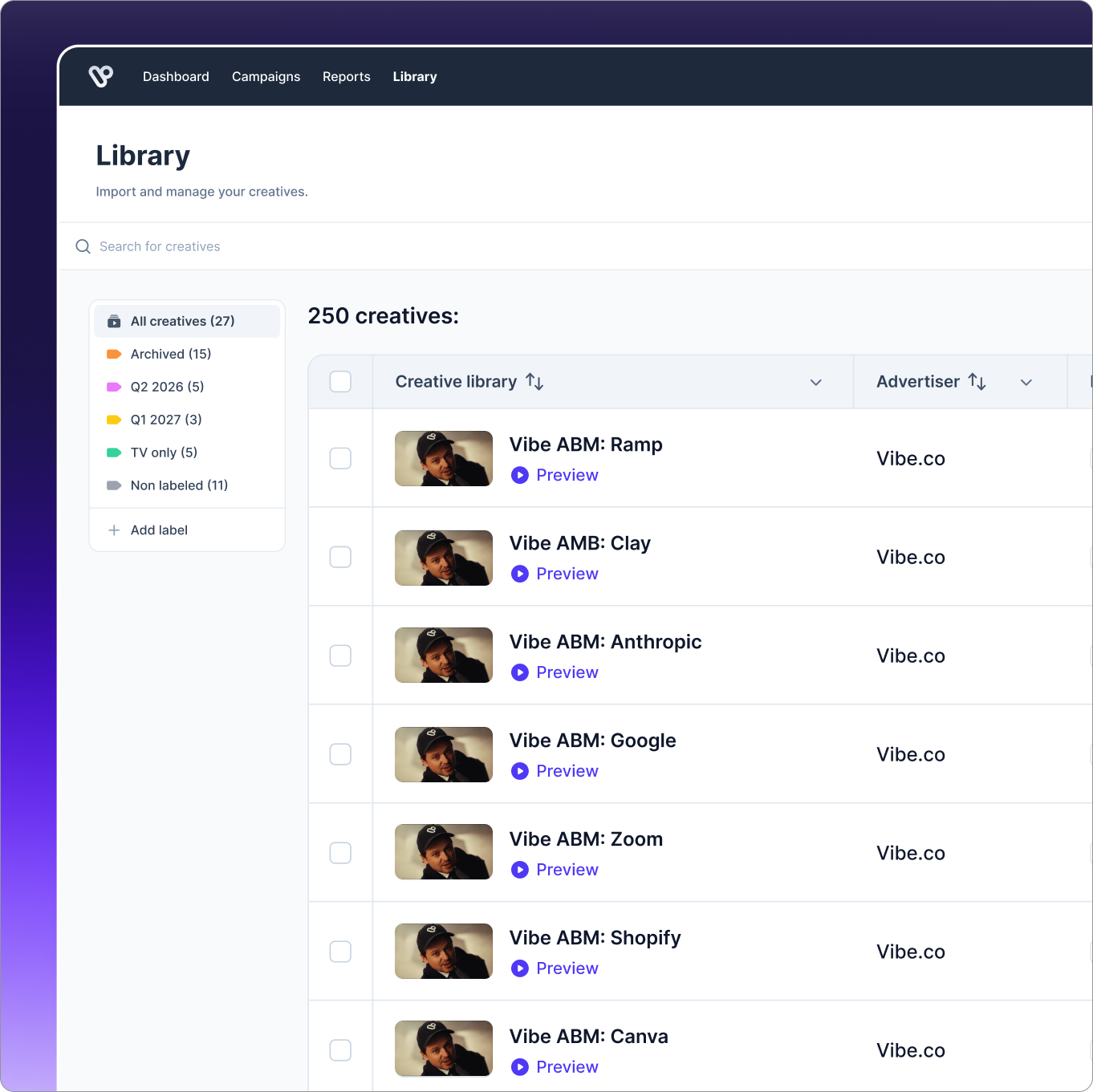
How the Vibe API turned 125 hours into 15 minutes
The old way of working meant a campaign this personalized either wasn't possible, or it was too costly to justify. Romain tested a different approach. He opened Claude, dropped in his list of 250 target accounts from Clay, and manually briefed the LLM on one of the campaigns. Once he saw Claude got it right, he let the Vibe API take it from there.
How did he do it?
- He started with a list of 250 target accounts and used Clay to enrich account data per company.
- That data fed into the API, which built a dedicated campaign per account: one audience, one budget, one set of targeting parameters, all matched to the specific business.
- Vibe's agency had delivered the 250 creatives in a spreadsheet, one per account.
- The API read the spreadsheet and matched each creative to its campaign automatically, with a 98% match rate on the first pass.
The campaign builder was never opened. No one manually uploaded or matched anything. The entire workflow ran out of a single chat interface.
What this means for you (if you're not running Vibe's growth team)
Romain's team didn't need to hire more people to pull off their dream ABM scenario. They used capabilities that are available to any advertiser on the platform today.
- Full API and MCP coverage: everything available in the Vibe UI is also available to automate. You don't have to click through campaign setup, targeting, or creative assignment one screen at a time.
- Vibe fits inside the tools you already use: the API and MCP plug into whatever your team already runs on, spreadsheets, CRMs, enrichment tools, so campaigns get built from data you already have, not a new system you have to learn.
- No engineering team required: MCP wraps that same API power as a chat interface. If your team isn't writing code, you get the same speed and scale without a developer handoff.
If you're running one campaign at a time today, this is how you get to ten, or two hundred fifty, without hiring to match.
Why this matters
The heaviest lifting, enriching and fetching data on hundreds of employees, ran unattended in the background for about 8 hours while Romain and his team worked on something else entirely. Romain explains, "It took time, but it wasn't my time. I could work on other things while it ran in the background." And running hands-off didn’t cost accuracy: the campaigns still matched creative to account at a 98% rate.
That time went to the agency brief: sharpening the creative, deciding how each account should be positioned, thinking through strategy instead of mechanics.
That's the shift. Not less work, different work. The team's time moved from clicking through configuration screens to the creative and strategy that actually moved performance. Marketers get to focus on marketing.
“Now your job is strategizing how you can get noticed and build your business, and how you sell what you're trying to sell.”
Want to see what the Vibe API can automate for your team? Book a demo.
450 Apps Have Launched on Vibe's Developer Platform Since June
450 Apps Have Launched on Vibe's Developer Platform Since June
450 apps have launched on Vibe's Developer Platform since June, bringing CTV into audience, CRM, measurement, and creative tools via API.
Twilio Segment now sends conversions to Vibe.co
Vibe is now a conversion destination in Twilio Segment. Send the events you already track to Vibe server to server and measure CTV results.
Smarter bidding across every goal
Keanu 4.0, Carrie-Anne 1.5 and Laurence 1.0 are live on every Vibe.co campaign: +26% more outcomes at constant budget, +36% more households reached.
Fairing on Vibe: post-purchase answers become CTV conversions
Connect Fairing to Vibe so your streaming TV channels appear in your post-purchase survey, and the customers who credit TV come back as conversions.
Design in Canva, run on TV
Vibe is now the first CTV destination in Canva's publish menu. Design a video ad in Canva and publish it straight to your Vibe creative library.

Get started with Vibe
in minutes.


Industries
© 2026 Vibe, Inc.