
Fairing on Vibe: post-purchase answers become CTV conversions
Fairing, the leading marketing attribution survey platform that measures direct customer feedback through post-purchase surveys is live in Vibe's integration marketplace. Your Vibe campaigns now populate as answer options inside Fairing's post-purchase survey, and every customer who credits a TV placement sends a conversion back to Vibe through the Conversions API in real time.
If you already run Fairing on your storefront, most how-did-you-hear-about-us questions end at "TV." Once you connect the integration, that same question lists the channels and programs your Vibe campaigns actually ran on, so a customer can pick the one they saw. Their answer lands in Vibe as a conversion alongside the ones you already track from your store, your call tracking, and your CRM.
Availability
Fairing is available today to every Vibe advertiser, listed under Attribution & Measurement in the integration marketplace. Connect it from your Vibe dashboard or install it from Fairing's side. Setup runs through OAuth and takes minutes, with no engineering work on either end.
Fairing's post-purchase survey installs on Shopify and other storefronts. The full setup guide is at docs.fairing.co/docs/vibeco.
What a declared answer adds
Vibe already reports your CTV performance against the tools you use, with native connections to Northbeam, Triple Whale, Fospha, and others in the marketplace. Those tools work from what they can observe: a click, a view, a geo test, a model.
Fairing’s attribution pulls from what the buyer actually says. A customer who just checked out gets asked where they heard about you, and answers in their own words. That signal has a property none of the observed ones do; it comes from the person who made the purchase, at the moment they made it, and it isn't impacted by ad blockers, VPNs, private browsing, etc. And because it lands on the order, nothing has to be matched afterward. The customer arrives already connected to the channel they credited.
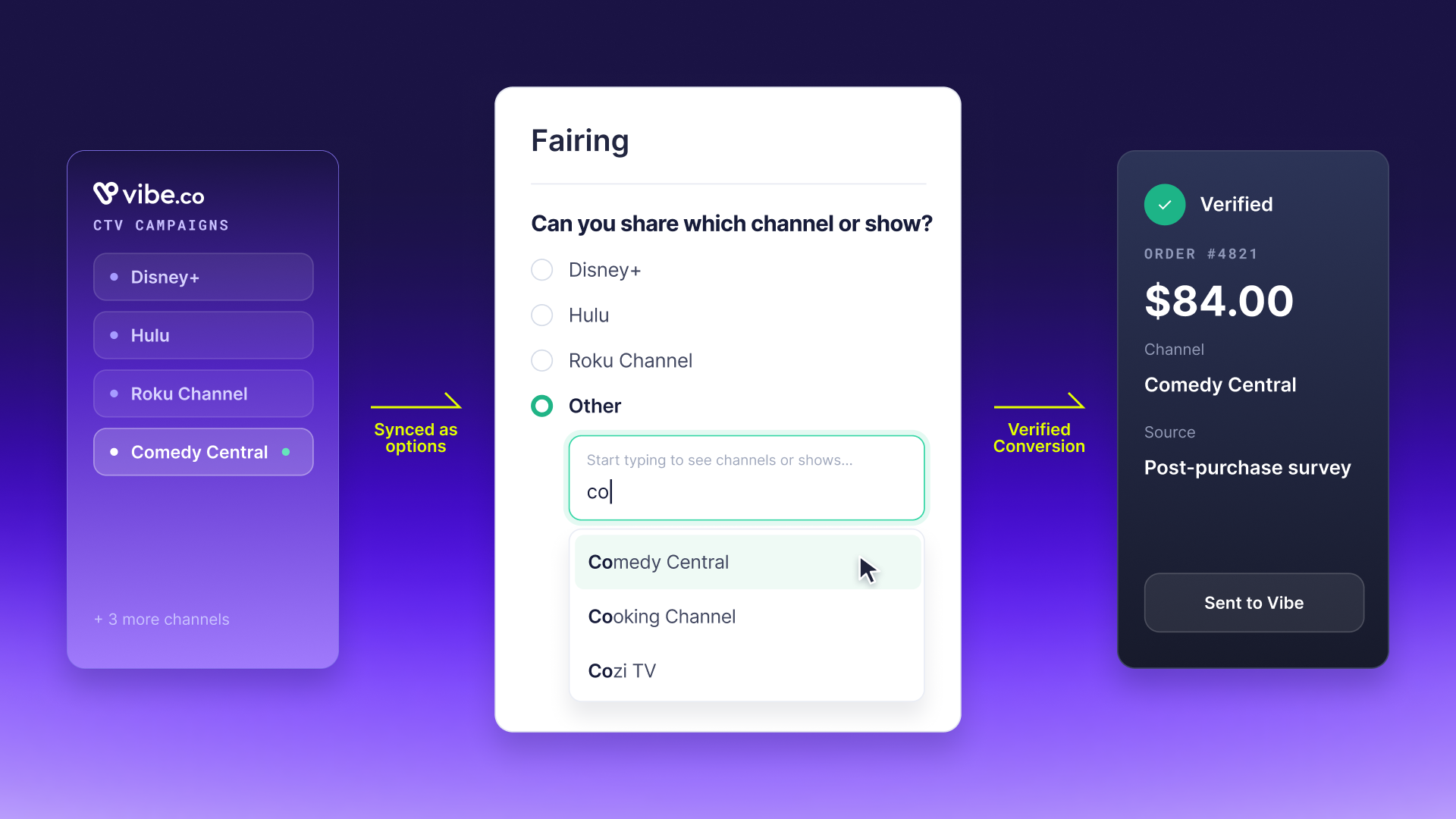
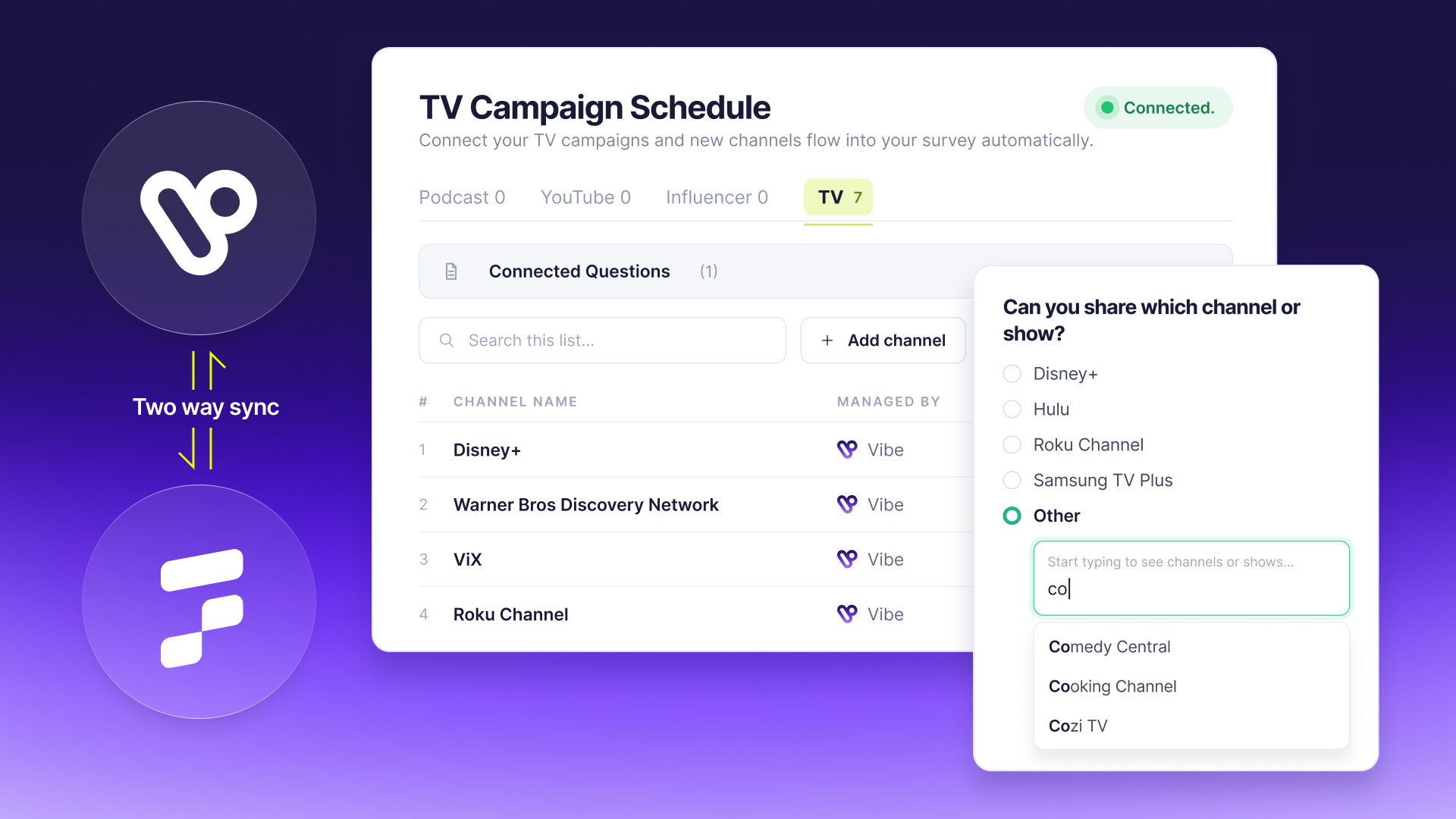
Until now, a TV answer in that survey stayed generic unless brands spent time maintaining followup questions & show/channnel lists. If not, omebody typed or picked "TV" and the answer stopped there, without a channel, a program, or a campaign attached. By connecting Vibe to Fairing, the answer options are drawn from your live Vibe buys, so a customer picks the specific placement rather than the medium, without any extra work. Fairing's contextual follow-ups sharpen it further, separating streaming from linear and narrowing to the app or show where your spot ran.
Fairing reports response rates between 30-70%, which means a meaningful share of your orders carry a buyer-declared answer rather than a modeled one.
How the connection works
Four steps, end to end.
Install Fairing. Add the post-purchase survey to your Shopify or other storefront. This takes minutes, no dev needed.
Connect Fairing to Vibe. Authorize the integration. Your Vibe campaigns sync into your Fairing survey, so customers can find and credit the exact placement that reached them.
Collect and sync responses. Every time a customer answers your attribution question with a TV response, Fairing posts that conversion to Vibe's Conversions API.
Watch your Campaigns get Smarter.. Those conversions become an optimization signal in Vibe, so your buys shift toward the placements customers are naming.
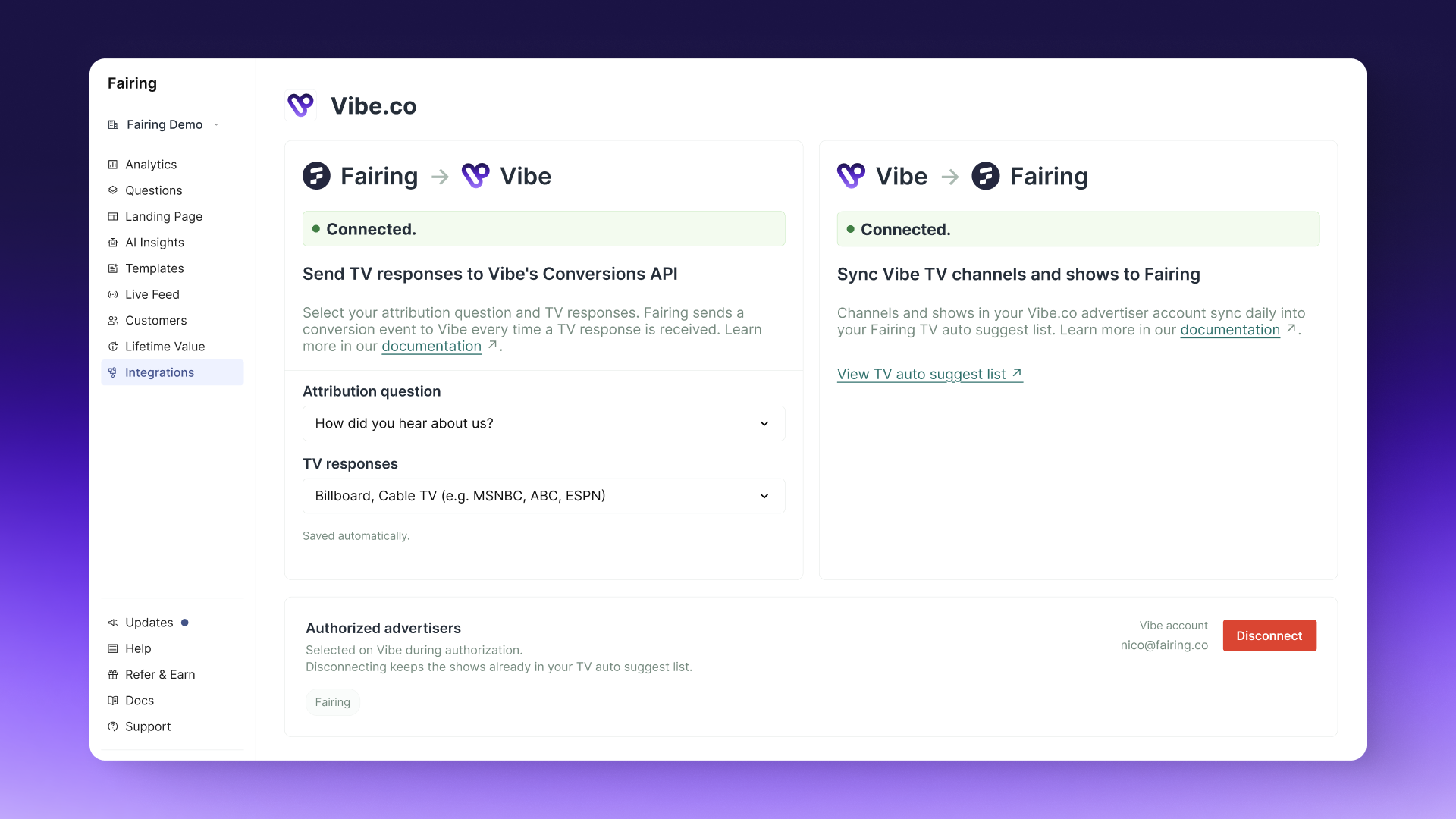
The sync runs both directions. Your live Vibe buys keep the survey's answer list current, and credited responses flow back to Vibe as conversions. The integration also supports passing complete cart and order details, so you can measure and optimize CTV against product and order data rather than order count alone.
What the answers let you change
Placement-level reallocation. A conversion tied to a specific channel or program tells you where to put the next dollar, not just that TV worked in aggregate. Say your spend is spread evenly across news, sports, and lifestyle programming, and the survey responses come back concentrated in one of the three. That is an instruction, and you can act on it in the same week rather than at the end of the flight. Your Vibe strategist can read the responses with you and move budget while the campaign is still running.
New customer quality. Pair survey responses with AOV, LTV, and first-time versus repeat status to see what kind of customer your CTV spend is bringing in, not only how many.
Cross-channel comparison on one basis. Fairing asks every new customer the same question regardless of channel. That gives you a single, consistent buyer-reported view across TV, paid social, search, podcasts, creators, and word of mouth, which is useful precisely because those channels are otherwise measured in different currencies.
Where Fairing sits in your measurement stack
Fairing sits alongside your incrementality testing and your attribution platform as one more input. It reports what customers say about where they found you, and you weigh that against what your models estimate
Most attribution and measurement tools answer the question by inference, each with its own model. Fairing answers it by asking the customer, and it feeds those answers as an additional signal into the measurement platforms you already run such as TripleWhale, Fospha, and WorkMagic. A model and a survey give you two independent readings on the same spend, and the places where they agree are the ones worth acting on fastest. Where they disagree, a few hundred customers naming a specific channel gives you somewhere concrete to start
Limits worth knowing
Self-reported attribution is a sample, not a census. It covers the customers who answer the question, and their answers reflect what they remember rather than a logged event. Memory is imperfect, and people sometimes credit the most recent thing they saw rather than the thing that first moved them.
Fairing mitigates this with response validation and contextual follow-ups, and Vibe's placement list removes most of the guesswork by giving customers a specific, recognizable option instead of a blank field. Even so, treat these conversions as one signal among several. The strongest read comes from putting buyer-declared results next to your deterministic conversions and your incrementality tests and looking at where all three point the same direction.
What to run first
If you are already running Vibe and Fairing separately, connect them and leave the survey untouched for two weeks. You want a clean baseline of how often TV comes back as an answer before you change anything about the question.
After that, use the placement-level responses to split your budget test. Take the two channels customers name most often, raise their share, and watch whether the response mix shifts with the spend. That loop is the fastest way to find out whether the signal is telling you something your other tools are not.
Getting started
Add Fairing from the Vibe integration marketplace, or connect Vibe from inside Fairing. The setup guide lives at docs.fairing.co/docs/vibeco. If you are not running Vibe yet, you can start a campaign in a few minutes and connect Fairing once it is live.
Your customers have been answering this question since the day you installed Fairing. Now the answer lands where you buy the media.
Connect Fairing to Vibe and let your next order tell you which spot worked.
Design in Canva, run on TV
Design in Canva, run on TV
Vibe is now the first CTV destination in Canva's publish menu. Design a video ad in Canva and publish it straight to your Vibe creative library.
Introducing Omnisend for Vibe
Sync Omnisend segments to Vibe and run them as Streaming TV audiences.
Introducing Vibe CLI
Run CTV campaigns from your terminal or coding agent with Vibe CLI. Query performance, launch campaigns, and script the repetitive work. Live now.
Introducing Stella for Vibe
Vibe now connects to Stella, so performance marketers can measure CTV with causal proof, not guesswork.
Introducing L2 for Vibe
Send custom voter and consumer audiences from L2 straight into Vibe and run them on connected TV - no exports, no manual handoff.

Get started with Vibe
in minutes.


Industries
© 2026 Vibe, Inc.