
70% of Americans Think Their Phone Is Listening to Their Conversations. Is It?
Most of us have had the experience. You mention something out loud—a jacket someone was wearing, a blender your friend just got, a supplement your coworker won’t stop talking about—and within hours, you’re looking at an ad for it. Not for something in that category. For that exact product.
The obvious conclusion: your phone is listening.
It isn’t. But the real explanation is arguably more impressive than audio surveillance, and considerably stranger.
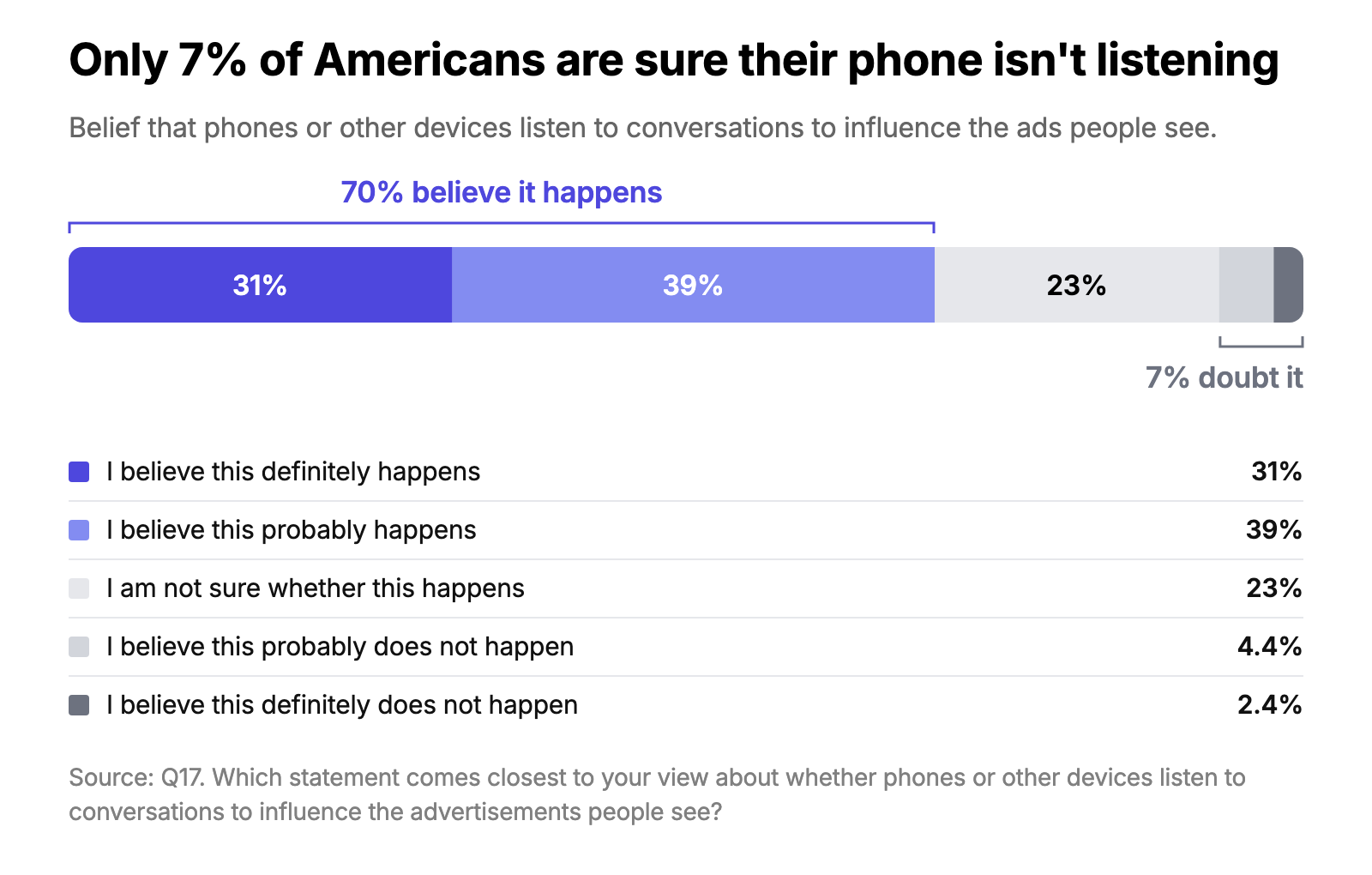
A new survey of 1,000 American adults, commissioned by Vibe found that 70% of Americans believe their phone is listening to their conversations to influence the ads they see. Thirty-one percent say it definitely is. Only 7% doubt it.
They’re not being paranoid. They’re being logical. When an outcome seems too precise to be coincidence, and nobody in the ad industry has ever bothered to explain how it actually works, “it must be listening” is the simplest theory that fits.
Your behavior is louder than your voice
Modern ad targeting doesn’t need your microphone because it has something better: your behavior. Not just what you click, but what you slow down on, what you search twice, where your phone has been, what the other devices on your home network are shopping for, and what millions of people with habits similar to yours ended up buying.
None of this starts with your name or who you are. Ad platforms work with behavioral signals, patterns of what people do, not records of who they are. Here’s what those signals actually look like:
- Search patterns. When you search for something, the signal isn’t “Jane searched for running shoes.” It’s “someone searched for running shoes twice this week.” The platform sees a category of intent, not a person.
- Time spent. How long you engaged with a page, whether you returned to it, whether you opened several tabs on the same topic. These signals indicate genuine interest without recording what you actually read.
- Location patterns. Aggregate location data shows that phones in certain areas tend to belong to certain kinds of shoppers, like “people who visit gyms also buy protein supplements.” It works at a population level more than it tracks any one person’s movements.
- Device identifiers. Every phone and connected TV has a built-in advertising ID—an anonymous code, not tied to your name or email—that helps platforms understand which devices belong to the same household. This is actually more privacy-protective than the older method of using IP addresses, which are shared across apartment buildings and change unpredictably.
- Household signals. Devices that consistently connect from the same location get grouped together. The system doesn’t know who lives there, just that the browsing patterns coming from that address tend to look a certain way.
- Lookalike modeling. This is where it gets genuinely interesting. Advertisers can reach people who share behavioral patterns with their best customers without ever knowing who those people are. No name. No file. Just a pattern that resembles one they’ve seen before.
Put those signals together and you get something that predicts purchase intent quite well, without ever needing a name, a face, a personal record…or an eavesdropping session to your phone.
So, why did that ad show up right after you thought about it?
There’s something else happening too.
Cognitive scientists call it the Baader-Meinhof phenomenon (otherwise known as the “frequency illusion”). You spend twenty minutes looking at a couch on a Tuesday. By Thursday you’ve seen it four times—in a feed, in a banner, in a sidebar. The couch was already in circulation. Tuesday is just when you started looking. Once something enters your awareness, you start noticing it everywhere.
When you mention something out loud, it’s already on your mind. You’re primed to notice the next related ad you see. The gap between the conversation and the ad feels like an hour. It might be coincidence. Your brain just finally made the connection.
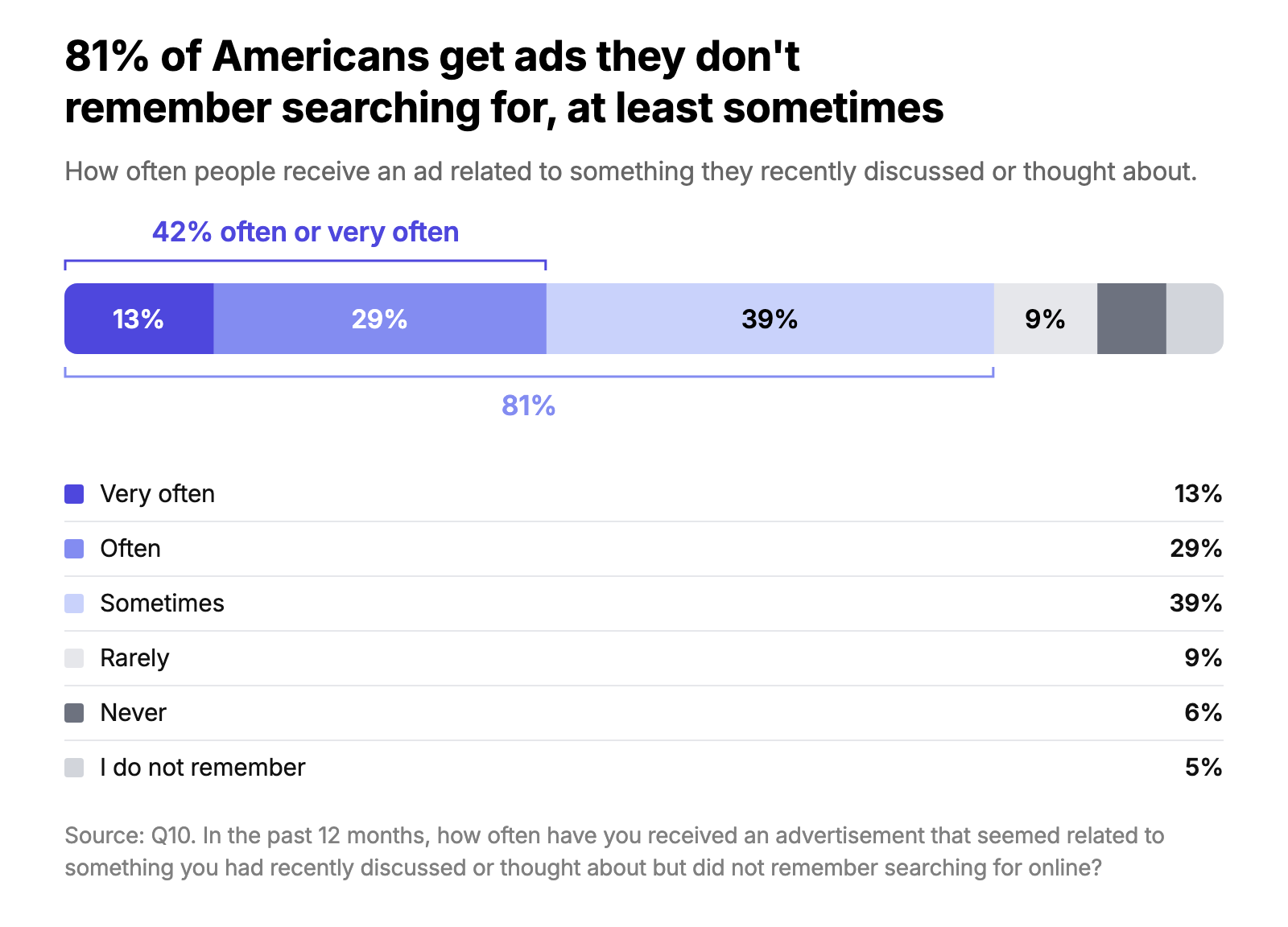
The survey found that 81% of Americans say they’ve gotten an ad for something they only discussed or thought about, never typed—and 42% say it happens often enough that it no longer feels like coincidence.
How people react to well-targeted ads
The room splits almost evenly. Among those who’ve had this experience, 23% found the ad convenient and the same share were impressed by its accuracy. Another 27% were simply curious how the advertiser knew. But 31% felt watched, and 27% were uncomfortable.
The reaction tracks closely with how much someone understands about how targeting works. Sixty-four percent of Americans now know that AI helps decide which ads they see. Among those who understood the mechanism, comfort ran considerably higher. Understanding the system shifts the emotional read from surveillance to service.
Generation plays a role. 34% of Gen Z report feeling impressed when uncanny ads happen to show up on their feed or TV, compared to 7% of Boomers. Younger users grew up inside algorithmic personalization. The surprise isn’t that targeting is personal. It’s when it isn’t.
How your TV fits into this
The same machinery now extends to your living room screen, and this is where things get genuinely sophisticated.
For years, ad platforms tried to connect your devices using your IP address, the number your internet provider assigns to your home network. The problem is that IP addresses are unreliable identifiers. They change. They’re often shared across an entire apartment building. On a college campus or at a large employer, thousands of people appear to be the same “household” by IP alone.
The newer approach is called identity resolution, and it’s considerably more precise. Platforms like Vibe build what’s known as an identity graph—connecting device advertising IDs (the anonymous identifier built into every phone and connected TV), publisher-provided identifiers, and email-based signals that have been cryptographically scrambled before use, so no actual email address is ever stored or transmitted.
The result is a system that resolves identity at three levels: the individual, the household, and the shared network. Your phone and your living room TV can be recognized as belonging to the same home. A college dorm’s shared Wi-Fi doesn’t get mistakenly treated as one giant household. Your office building doesn’t receive the ads targeted at your personal browsing.
That last point matters more than it sounds. An ad platform that can’t distinguish your home from your employer is frequency-capping your household separately on every device, which means the same ad might appear to every family member dozens of times while appearing to the advertiser as only a handful of impressions. The identity graph solves that. Ads are managed at the household level, because that’s actually how people make purchasing decisions.
The survey found that about 54% of respondents who tried to actively influence their ads said the
same campaign started following them across platforms—showing up in a feed and again on a TV screen during the same week. That’s identity resolution working as designed.
The people getting the best ads figured something out
Here’s the part the ad industry rarely mentions: most Americans are already shaping their own ads. On purpose.
Eighty-four percent of American adults took at least one action in the past year to influence what they were shown, like visiting competing websites, searching a product more than once, watching category videos, engaging with relevant content. Sixty-one percent of those people say they did it on purpose.
It works, at least partially. Forty-eight percent who tried these tactics said their ads became more relevant.
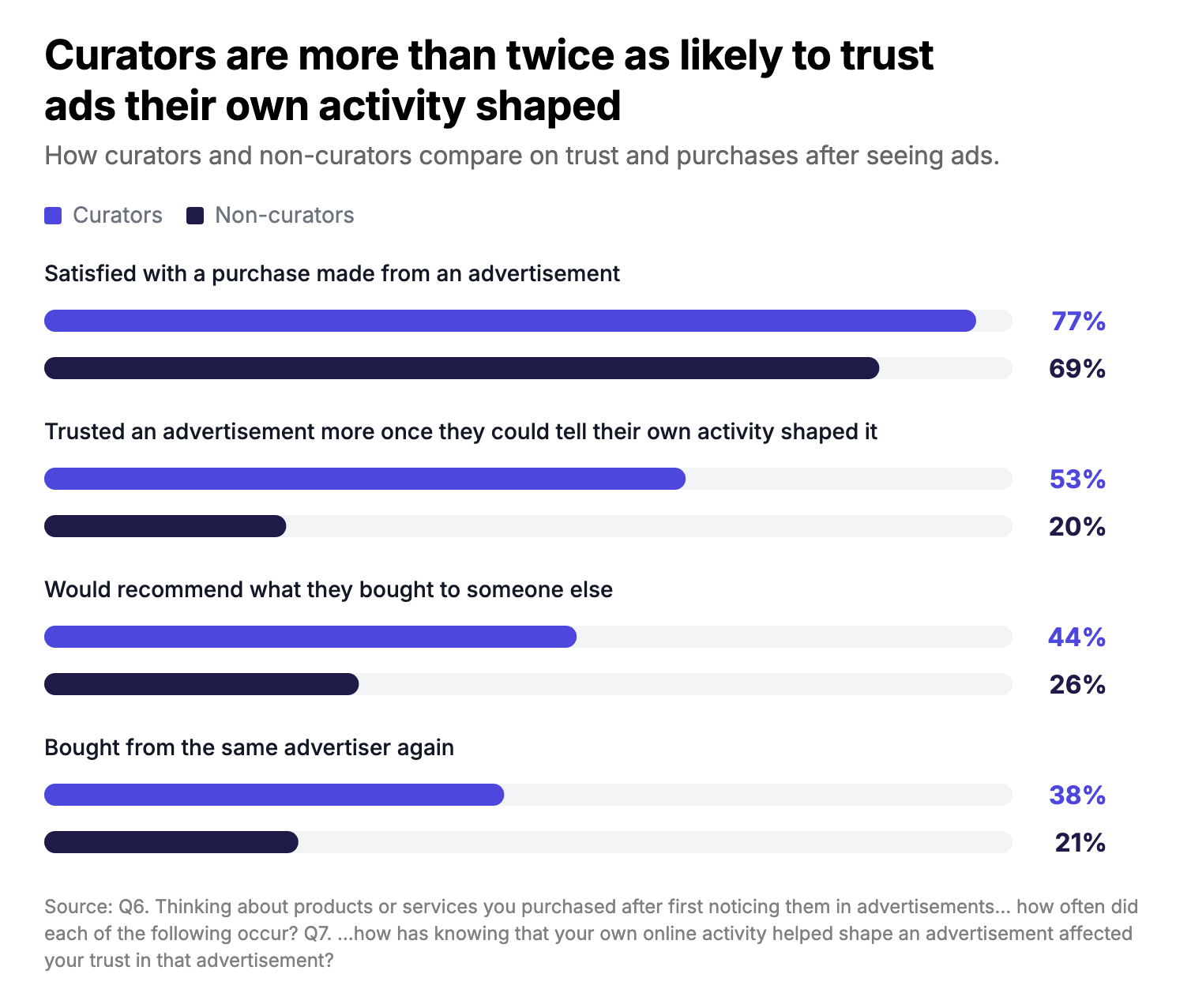
The people in this study who actively shaped their ad experience reported being more satisfied with what they bought, returning to the same brands at nearly double the rate, and recommending what they bought far more often than those who let the algorithm run unattended.
Understanding the system, it turns out, makes it work better, not just for advertisers but for the people on the other end of that ad.
Your phone isn’t listening to your conversations. It has never needed to. What it has is a record of almost everything else, and a remarkably precise model of what that record suggests you’ll want next.
Methodology
Vibe surveyed 1,000 U.S. adults via Pollfish who use ad-supported websites, social media platforms, apps, or streaming services.

Can CTV Advertising Platforms Measure Foot Traffic?
Can CTV Advertising Platforms Measure Foot Traffic?
CTV advertising platforms can measure foot traffic for retail brands using geographic holdouts and identity graph matching. Here's how it works on Vibe.
How to Target ZIP Codes with Streaming TV Ads
ZIP code targeting on streaming TV reaches specific households without wasting budget on a full DMA. Here's how it works — and how to set it up on Vibe.co.
How to Structure a CTV Test and Learn Framework
How to structure a CTV test that produces usable data in 4 weeks — hypothesis, budget, measurement setup, and decision criteria for performance marketers.
How to Budget for CTV Advertising
Connected TV budgets don't need to start big — they need to start smart. Here's how to set, split, and scale your CTV ad budget.
How to Attribute Phone Calls to Your CTV Campaigns With CallRail x Vibe
Vibe's CallRail integration uses household IP matching to connect CTV impressions to inbound phone calls — so every call gets credited to the right campaign.

Get started with Vibe
in minutes.


Industries
© 2026 Vibe, Inc.