
84% of Americans watch TV with ads. Here's why.
By Senda Ben Abdallah
Every few months, the same email arrives: your streaming plan is going up. And every few months, the same small decision gets made on the plan-selection screen. One option is cheaper and comes with ads. The other doesn’t, and costs more. Plenty of us tell ourselves we’ll upgrade to ad-free eventually. Most of us don’t.
In a new survey of 1,000 American adults, commissioned by Vibe, 28% said they would pay extra to watch movies and TV without ads. Only about half as many actually did: in the past year, 16% paid for an ad-free or reduced-ad subscription.
Ad-free streaming has become the premium gas of TV: people like the idea, but most fill up with regular, and the car runs just fine. As prices keep climbing, that gap is turning the ad-supported plan into the way America actually watches.
Why most people never upgrade
The gap between what people say and what they do isn’t hypocrisy. It’s arithmetic. Telling a survey you’d pay to skip ads costs nothing. Actually paying means a recurring charge, and that charge keeps rising. The average price of an ad-free streaming plan has climbed from $9 to $16 a month since 2020, a 78% jump, according to an analysis by The Verge cited by eMarketer.
Faced with that bill, most people make a clear-eyed trade. 64% of Americans would rather watch ads on movies and TV than pay more to remove them. For most viewers, a few minutes of commercials is a fair price for keeping the monthly bill down.
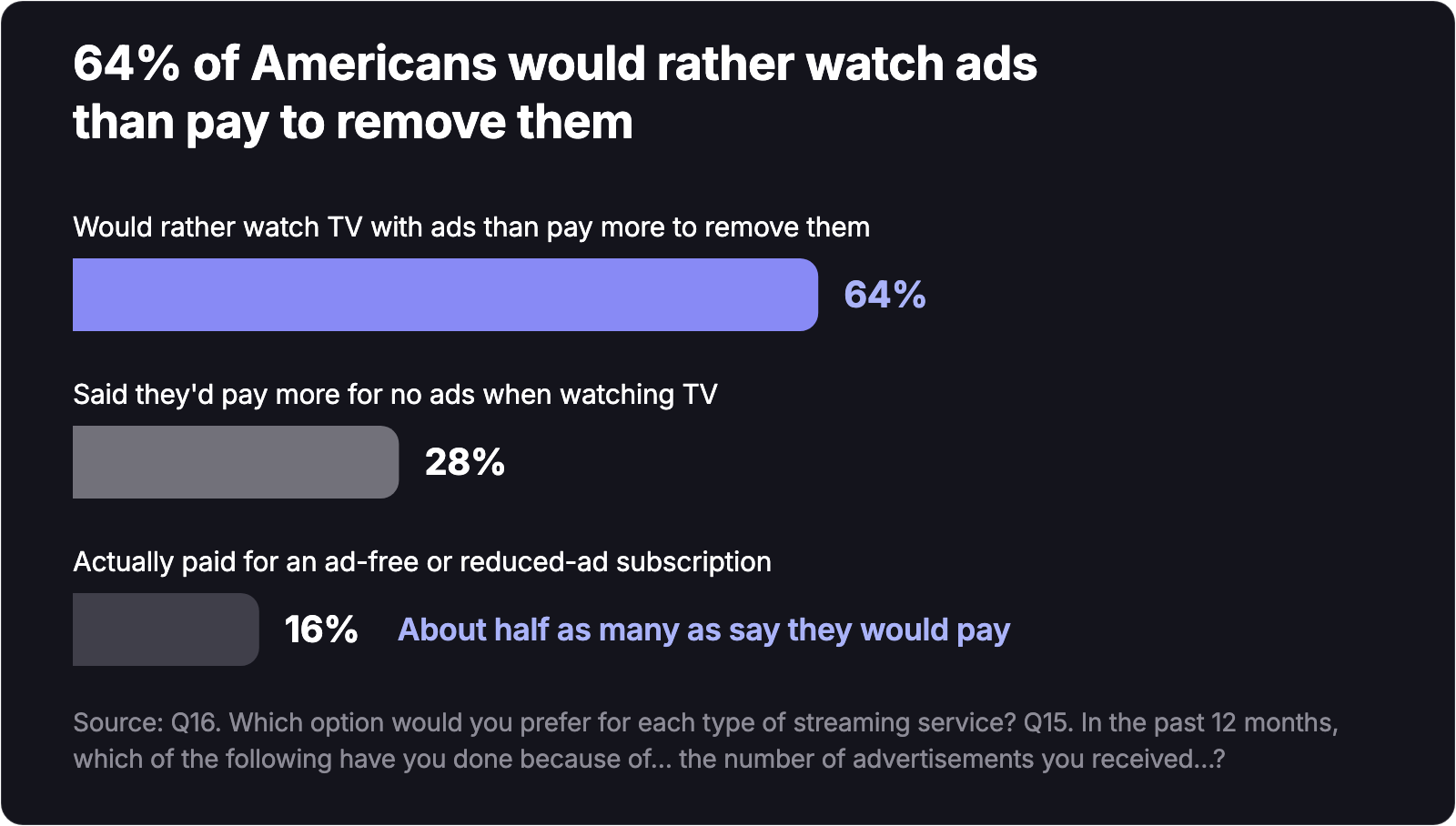
The gap between wanting ad-free and actually paying for it
The obvious explanation is that people simply can’t afford to go ad-free. The data says otherwise.
If ad-free were a luxury, wealthier households would be the ones buying it. They aren’t. Roughly one in six people paid to cut down on ads at every income level, from households earning under $50,000 to those earning more than $100,000.
What does predict it is age. Gen Z is four times as likely as Boomers to have paid to cut down on ads: 28% compared with 7%. Boomers grew up with broadcast TV, where the commercial break was simply part of the show, and many still treat it that way: 40% of Boomers would choose a free service with more ads, compared with just 16% of Gen Z. Gen Z grew up with skip buttons and on-demand everything, where an ad break feels like more of an interruption.
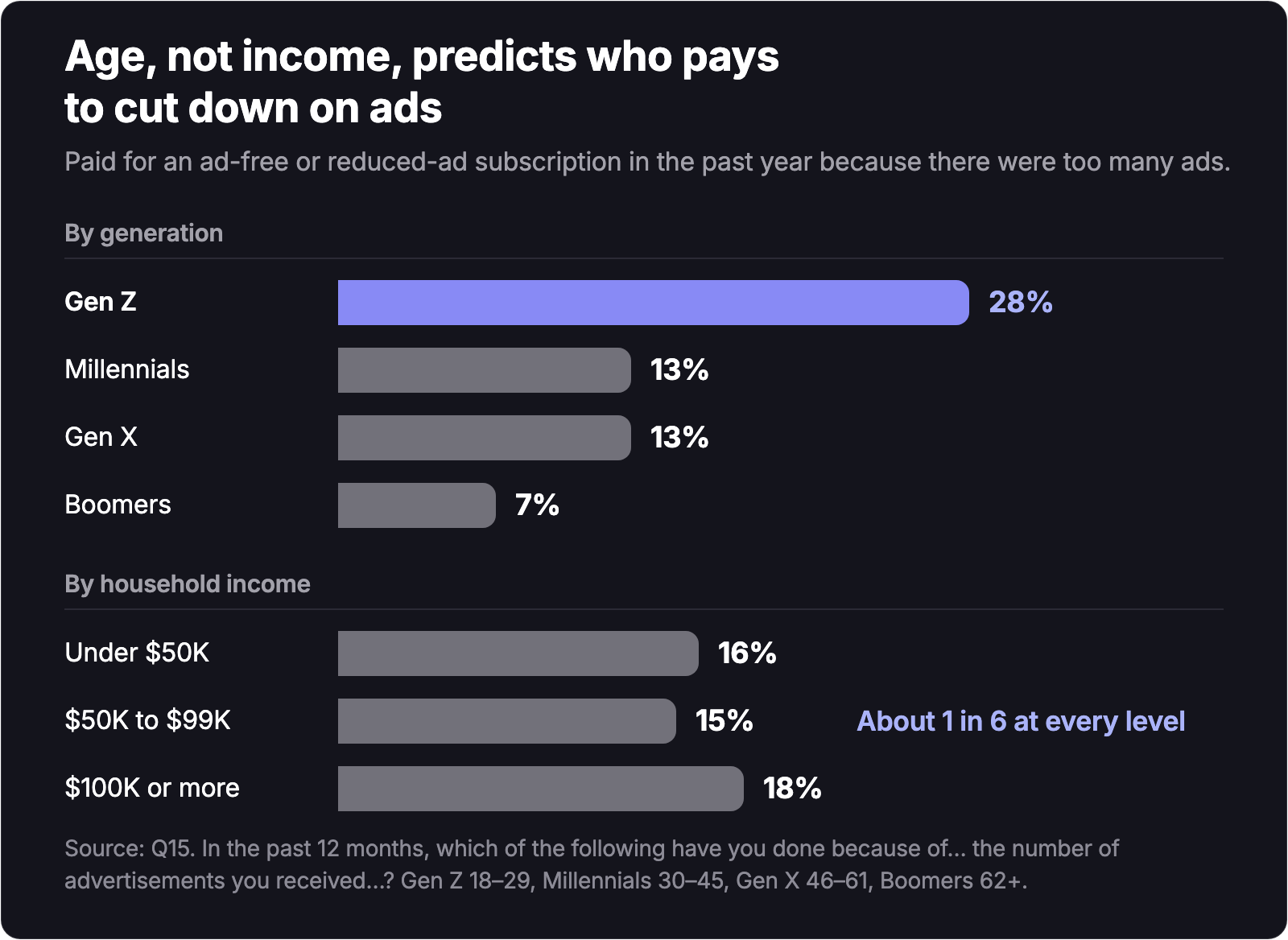
Gen Z doesn’t want zero ads. It wants better ones.
Here’s the twist. The generation most willing to pay to avoid ads is also the one most open to a different kind of ad. Gen Z was the generation most likely to choose a cheaper plan with ads tailored to their interests: 18%, compared with 5% of Boomers.
That isn’t necessarily a rejection of advertising. It’s a set of terms. Gen Z will trade its attention for a lower price, as long as what it’s shown feels like it was meant for them.
What this means for advertisers
For years, streaming services have positioned ad-free as the premium product and ads as the compromise. Viewers have quietly flipped that. The ad-supported audience isn’t a leftover group of people who couldn’t afford better. At every income level, it’s the mainstream. Industry data points the same way: ad-supported plans accounted for 71% of new U.S. streaming subscriptions over the nine quarters to early 2025, according to Antenna data reported by eMarketer.
That changes the job for brands. The audience on an ad-supported plan is largely there by choice. The ads that earn their place will be the ones that feel relevant rather than interruptive, especially to younger viewers, who have made clear they’ll accept ads, just not bad ones. That holds even for live sports, some of the most valuable inventory on TV: nearly three in four people who stream sports would choose an ad-supported plan over paying more to go ad-free.
For viewers, a good ad-supported deal is easy to describe: ads that feel relevant to what they actually watch, that don’t repeat until they fade into background noise, and that clearly buy them a lower bill. Streamers and brands that deliver on those terms are pushing on an open door.
The next price hike
Every time a streamer raises the price of going ad-free, it’s betting that viewers will pay to make the commercials disappear. Most won’t. The next price hike isn’t likely to push people toward the ad-free plan. It will confirm what most of them have already decided: the ad-supported plan is the better deal.
Vibe surveyed 1,000 U.S. adults via Pollfish who use ad-supported websites, search engines, social media platforms, video platforms, mobile apps or streaming TV services. Results are weighted to the U.S. adult population. Generations are defined by age: Gen Z (18–29), Millennials (30–45), Gen X (46–61) and Boomers (62+). Full methodology available here.
This story was produced by Vibe and reviewed and distributed by Stacker.

Messages That Stick: How Memory, Budget, and Your Deadline Should Shape an Awareness Campaign
Messages That Stick: How Memory, Budget, and Your Deadline Should Shape an Awareness Campaign
There is no optimal frequency. How memory, budget and your deadline should shape a streaming TV awareness campaign, from elections to launches.
How Enterprise Brands Use CTV for Account-Based Marketing
Enterprise brands are using CTV to reach named accounts and buying committees. Here's how targeting, measurement, and CRM attribution actually works on Vibe.
Does CTV Work for Enterprise Brands?
TYR grew revenue 234.6% in 60 days. AirOps hit 12.9x pipeline-to-spend. Sijo Home cut new-customer CAC 57%. Here's what enterprise CTV looks like on Vibe.
70% of Americans Think Their Phone Is Listening to Their Conversations. Is It?
70% of Americans believe their phone listens to serve ads. The truth is more interesting — here's how behavioral ad targeting actually works.
Can CTV Advertising Platforms Measure Foot Traffic?
CTV advertising platforms can measure foot traffic for retail brands using geographic holdouts and identity graph matching. Here's how it works on Vibe.

Get started with Vibe
in minutes.


Industries
© 2026 Vibe, Inc.