
Introducing Keanu 3.5 + Carrie-Anne 1.0
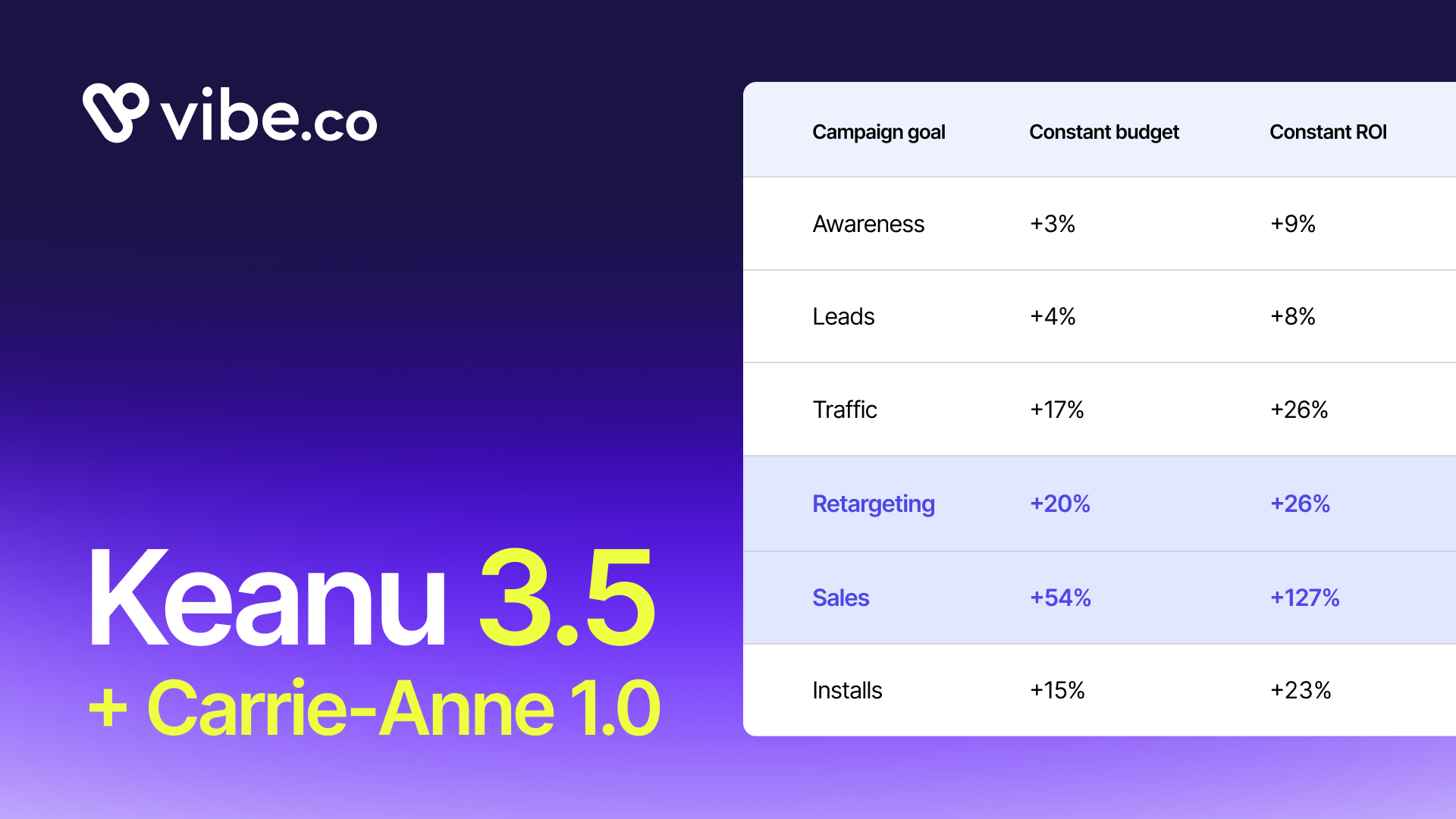
Yes, another release. No, not déjà vu.
Starting today, every campaign running on Vibe.co gets an even smarter bidding stack. Keanu 3.5 and Carrie-Anne 1.0 are now live across all campaigns with no action required on your end.
In live A/B tests, the combined release improved performance across all six supported campaign goals. Average gains across all six goals were +18% at constant budget and +35% at constant ROI.
If you are running a Sales campaign today, you are already getting in average +54% more outcomes from the same budget (when compared to Keanu 3.0). If you are running Installs, your cost per install just dropped without you changing a single setting. The improvements are live, applied automatically, and reflected in your results starting now.
Two upgrades, two problems solved
Every bid Vibe.co places has to answer two questions at once.
The first is a valuation question: how valuable is this impression for this advertiser, right now?
The second is a pricing question: given that estimated value, what is the right amount to pay in this specific auction?
Previous versions of the stack handled both with a single system (see Keanu 3.0). This release separates them cleanly. Keanu 3.5 owns the valuation layer. Carrie-Anne 1.0 owns the pricing layer. Each is optimized for its specific problem.
Keanu 3.5: better impression valuation
Keanu 3.5 is an improved implementation of our prediction model. It uses more signals than previous versions, particularly advertiser-level features and commerce events from our advertiser base.
This gives the model a richer view of what each advertiser is trying to achieve, how their users behave, and which impressions are most likely to produce a real outcome. The result is a more accurate estimate of impression value before the auction closes.
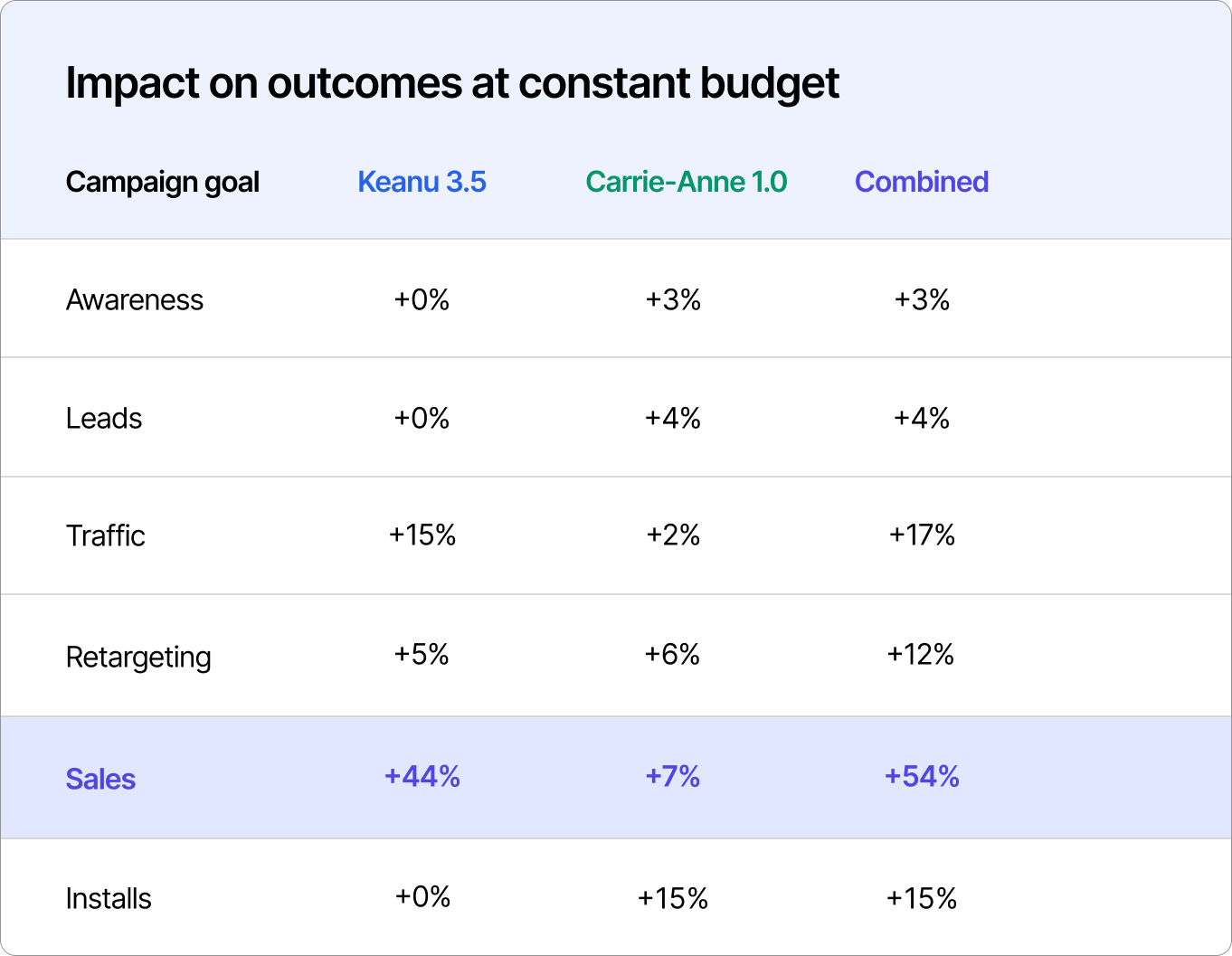
That accuracy matters most for goals where the value of an impression varies significantly across inventory. Sales campaigns saw the largest gains from Keanu 3.5 alone: +44% more outcomes at constant budget and +104% more scalable ad spend at constant ROI. Traffic came in at +15% and +23% respectively.
Carrie-Anne 1.0: better bid pricing
Knowing the value of an impression does not tell you what to pay for it. Auction dynamics, deal structure, floor prices, and win probability all affect what the right bid actually is. That gap between predicted value and optimal price is what Carrie-Anne 1.0 addresses.
Carrie-Anne 1.0 is our new value-to-price layer. It improves how the system translates predicted impression value into the right bid for the specific auction it is facing. When the opportunity is strong and the auction requires an aggressive bid, the system bids accordingly. When the opportunity does not justify the price, it holds back.
Its impact was positive across every tested goal, including goals where the valuation model's contribution was small. For Installs, Carrie-Anne 1.0 alone drove an average of +15% more outcomes while spending the same budget which translates to 23% when clients increase their spend to match their previous target. Leads improved +4% and +8%. Awareness improved +3% and +9%.
Results
We evaluated Keanu 3.5 and Carrie-Anne 1.0 through progressive live A/B tests against the previous valuation and pricing stack, including Keanu 3.0 and our prior price adaptation strategy. The targeted audience for each advertiser was split evenly between the new and previous stack, with equal budget on each side. We ran multiple iterations to confirm stability.
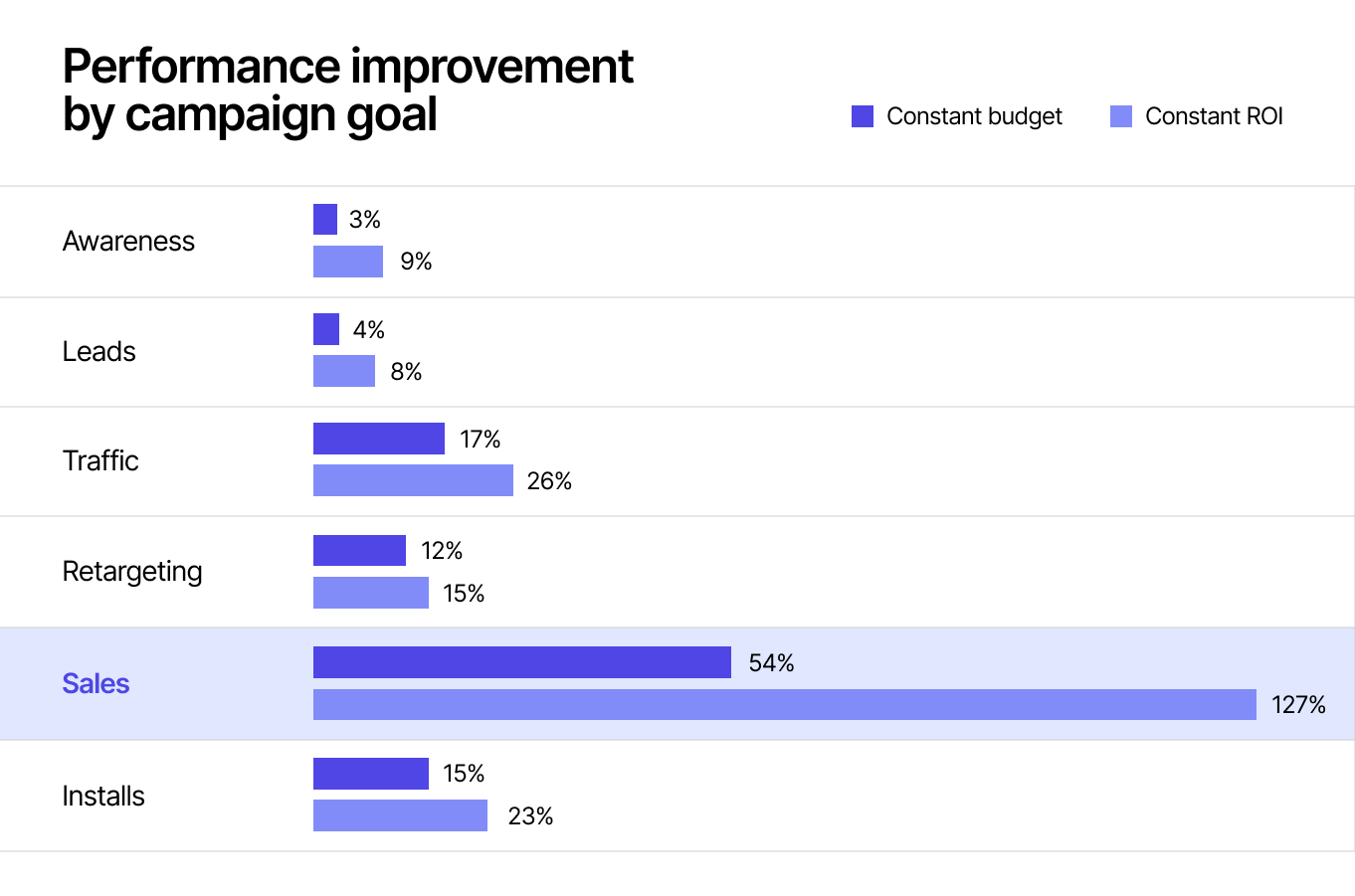
All six goals improved. Sales led at +54% at constant budget and +127% at constant ROI. Traffic improved +17% and +26%. Installs came in at +15% and +23%. Retargeting improved +12% and +15%. Leads and Awareness improved more modestly but consistently across both metrics. No goal regressed.
“With Keanu 3.5 and Carrie-Anne, we keep pushing CTV performance forward: better models, richer signals, and smarter bidding on every supply opportunity. The result is simple: more value for advertisers, more efficient monetization for publishers, and a stronger ecosystem for everyone.”
The breadth matters as much as the magnitude. A release that lifts one goal at the expense of another is a tradeoff, not an improvement. Keanu 3.5 and Carrie-Anne 1.0 improved all six goals. That is what happens when valuation and pricing are optimized together rather than in isolation.
How to read the two metrics
The constant budget view measures the direct efficiency gain at unchanged spend. If your campaign budget stays the same, this is how much more you get out of it. A +54% constant budget result for Sales means a campaign that was generating 100 purchases per week is now generating 154, at the same cost.
The constant ROI view estimates how much additional scale the improvement unlocks while maintaining the same cost per outcome. We calculate this using Vibe's budget-to-outcome elasticity system, which models the relationship between spend and outcomes per campaign type. This view answers a different question: if the system is now more efficient, how much more volume can you run before hitting the cost-per-result you were already accepting.
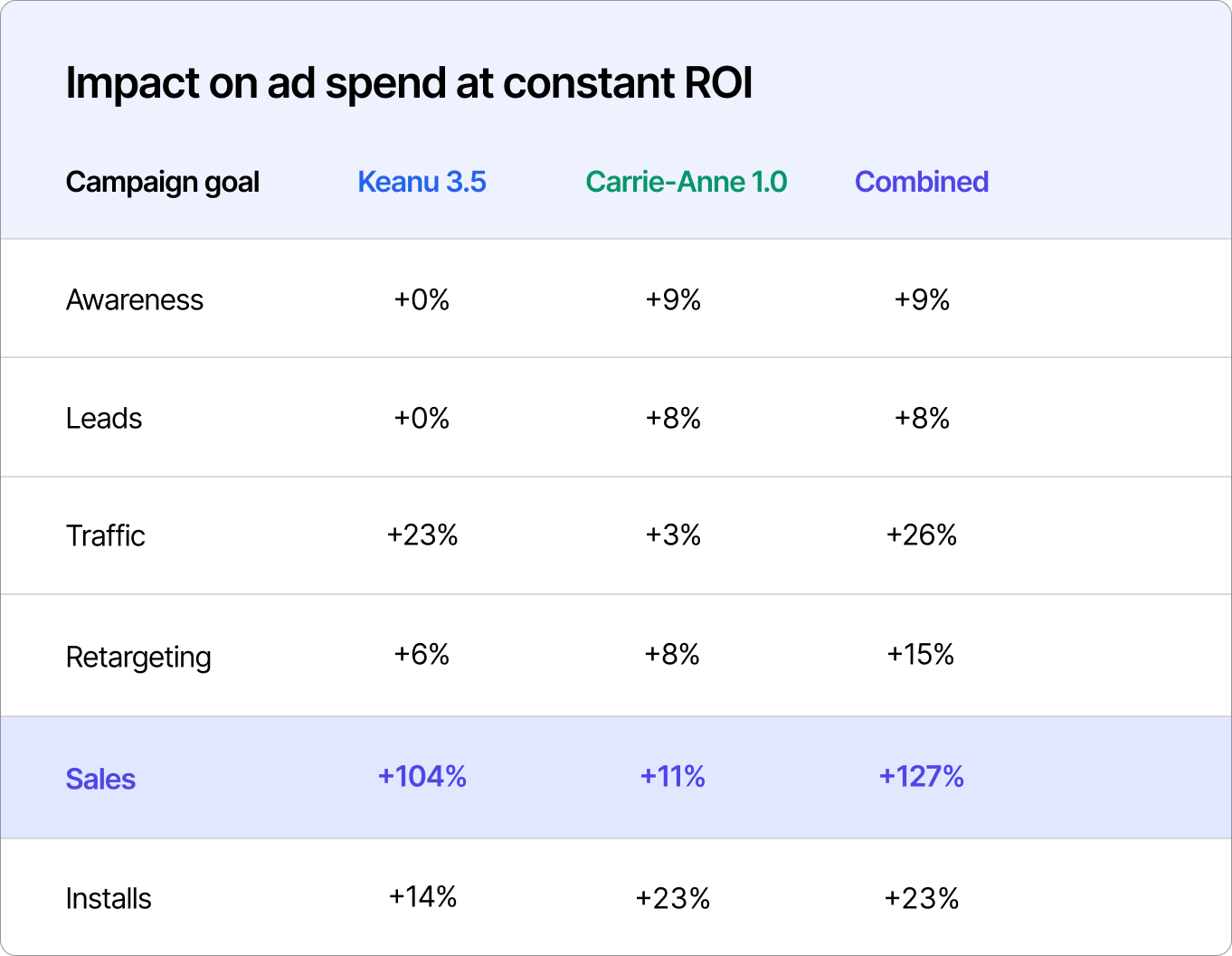
Both views improved across every tested goal. Your current campaigns get more efficient today, and there is more room to scale them at the same cost per result.
What comes next
Keanu 3.5 and Carrie-Anne 1.0 are part of ongoing investment in Vibe's performance infrastructure. Both models will continue to improve as they train on more data and as we incorporate new signal types. Future benchmark results will be published the same way we are publishing them today: with the methodology, the numbers, and an honest account of what changed.
Our next area of focus is supply and podding, where we see meaningful opportunities to improve efficiency further. We're also building toward incremental bidding — a smarter way to ensure every dollar is working on outcomes that wouldn't have happened otherwise. And we're working on better tools for advertisers to understand their scaling headroom, so budget decisions are grounded in data rather than guesswork.
Methodology
A/B tests were run at the advertiser level with a 50/50 audience split. Each panel received equal budget over the test period. Results were validated across multiple test iterations for stability. Constant ROI figures use Vibe's budget-to-outcome elasticity model and represent modeled projections, not directly observed outcomes.

How Vibe’s Growth Team Launched 250 Personalized Campaigns in less than 15 Minutes
How Vibe’s Growth Team Launched 250 Personalized Campaigns in less than 15 Minutes
See how Vibe's growth team used Vibe's API to launch 250 personalized CTV campaigns in under 15 minutes - and what it means for scaling ad ops.
Introducing Segwise for Vibe
Vibe opens a new partner category: creative management. Turn brand footage into CTV ads at scale. Segwise is the first partner, live today.
CTV just stopped being a separate tab. Introducing the Vibe MCP.
Vibe is now live in Claude, ChatGPT and Gemini. Query performance, launch campaigns, and explore TV inventory - all in conversation, no dashboard required.
Clay Ads + Vibe.co: Run CTV ads against your Clay audiences
Run CTV ads against your Clay audiences
Introducing the Freshpaint x Vibe.co Integration: HIPAA-Compliant CTV for Healthcare Marketers
HIPAA-Compliant CTV for Healthcare Marketers

Get started with Vibe
in minutes.


Industries
© 2026 Vibe, Inc.