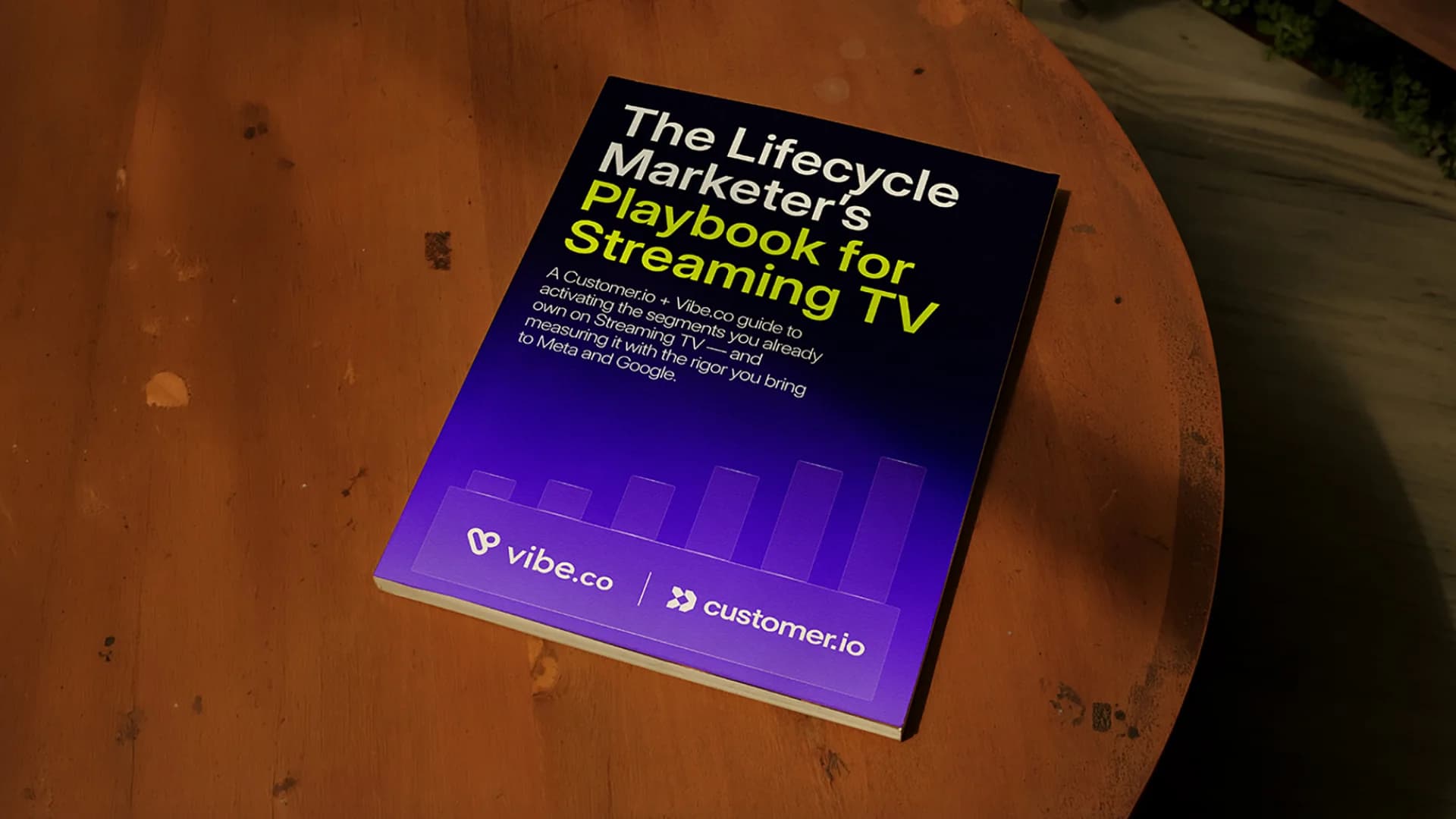
The Lifecycle Marketer's Playbook for Streaming TV
You've built a behavioral database that knows who's about to buy, who's about to churn, and who's ready to upgrade. This playbook shows you how to point it at a channel your competitors haven't touched yet — and measure it with the same rigor you bring to Meta and Google.
Key findings
- Your Customer.io segments are already your targeting: The exact segment that triggers your email campaign syncs directly to Vibe as a first-party custom audience — no data brokers, no probabilistic matching, no renting someone else's graph.
- CTV pays back 3x faster than Meta or Google: Vibe customers see ROI in ~3 months on average, vs. ~9 months for both Google and Meta, with an average 250% ROAS across the platform.
- The one-two punch outperforms either channel alone: CTV primes the customer in a high-attention moment; your Customer.io email lands hours later to close. The TV impression is often why the email finally gets opened.
- Retargeting warm audiences on CTV reduces CAC: A Northbeam-verified program found that syncing a CRM audience to Vibe for retargeting acquired customers at 57% lower cost than paid social.
Summary
This guide covers five specific lifecycle moments where pairing CTV with your existing Customer.io programs — email, push, and in-app — creates a combined effect neither channel produces alone: retargeting cart and browse abandoners, re-engaging onboarding drop-offs, nudging activation stalls, converting power users on base plans, and winning back churned customers. Each play includes segment definition, creative direction, measurement setup, and a 90-day launch framework.
What you'll learn
- How to sync Customer.io segments directly to Vibe as first-party CTV audiences
- Which five lifecycle moments deliver the fastest CTV payback, and how to sequence creative for each
- How to run real-time suppression so you stop spending the moment someone converts
- How to prove incrementality using holdout testing in Northbeam or Triple Whale
- How to seed lookalike audiences from your best cohorts and turn retention data into a net-new acquisition engine
Get the full report.
Download instantly - No signup required